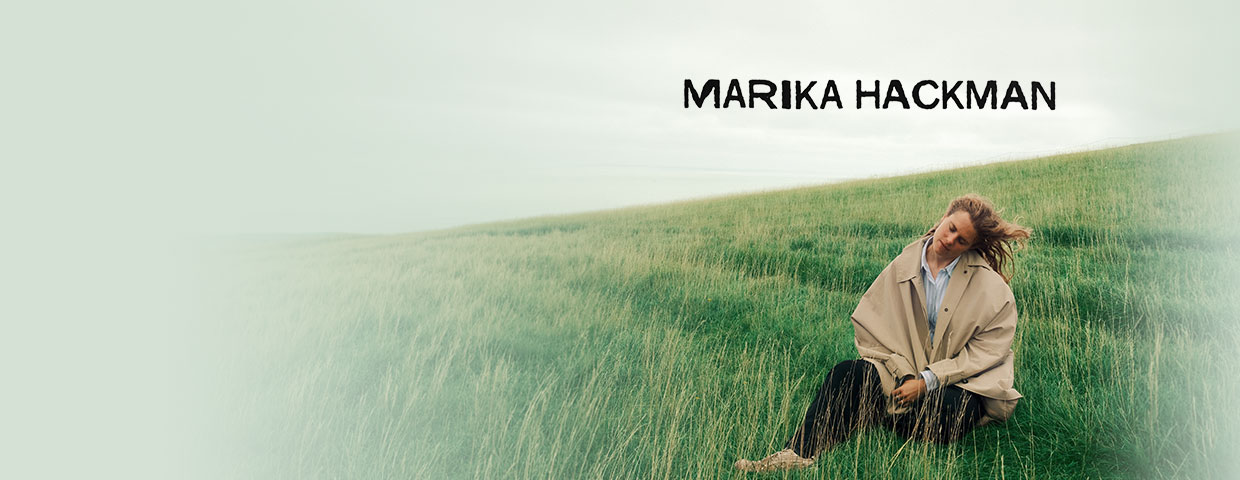
Marika Hackman – False Dogs
What is the sound of the reckoning of arriving at a future you were always travelling towards?
On False Dogs, Marika Hackman’s fifth album, she navigates the spectrum of emotions felt upon reaching milestones in your life previously imagined as a child. Produced, arranged and written by Marika herself, False Dogs is her most assured and emotionally affecting record yet: an intimate album about the beauty and anxieties of mid-thirties malaise. When the hedonistic romanticism of your twenties melts away; the stark reality of grief and a deeper understanding of the passage of time appears. The album references the imagined worlds often dreamed of as a child: the structures and ‘false gods’ unquestioningly believed in and so comfortably put aside with the wisdom of age. The playful spelling error of False Dogs acts as a nod to this changeability of our dreams, desires and belief systems. "Life has an arc of a carefree kid, to wild teenager, messy fun twenties, to getting married, having kids, jobs, responsibility… but actually that's not life. Life is joy, grief, anxiety, love and small moments – all of the things in between these perceived milestones," says Marika.
Known as much for her unique lyrical perspective, distinctive vocals and subtle guitar work; Marika’s deft multi-instrumentalism has gone quietly unnoticed on previous albums, having played almost every instrument across her catalogue — with the exception of her collaboration with friends The Big Moon on reactionary ‘I’m Not Your Man’ and the sweeping orchestral moments on Big Sigh. This understanding of the tone and character of a wide instrumental range informed the intricate arrangements found across False Dogs. Almost completely acoustic, immediate drums interlock with syncopated mandolins whilst earthy sub harmonium tones provide a backbone to urgent pianos.
Continuing to sharpen her production skills, the fresh and lively sonic palette of False Dogs was constructed through hours of playful experimentation at her own East London studio, armed with a few select microphones, a small jazz drum kit and a diverse instrument collection gathered over her twenty years of music making. Hackman’s approach was to focus on songwriting and arrangement - capturing the sound of her instruments as honestly as possible. Tonally, inspiration came from the rawness of early noughties radio that served as the soundtrack to so many car journeys stuck in the back seat as a teenager.
The production was solidified during a 10-day stint at Ramsgate’s Big Jelly Studios (aided by previous collaborator Charlie Andrew and Polly Mackey aka Art School Girlfriend - Hackman’s wife). Making use of the converted chapel’s roomy acoustics — coveted by artists such as Caroline and Mount Kimbie — the sound of the Kent coast can also be heard in field recordings subtly peppered across the record. The shoreline’s waves recorded on a pre-studio dog walk; Bonfire Night’s fireworks and church bells heard at the end of depression anthem “Be Surprised” - recorded in real-time as Mackey moves a microphone from Marika’s acoustic guitar and out of the studio, into the night.
False Dogs sees Hackman casting aside the boundaries of conventional song formation she had worked within previously. "The writing felt quite direct and a little less controlled, which I think gives it an energy I haven't captured before," says Marika. This structural liberation manifests in a lightness most apparent on “Lying Down”, a soaring meditation on hangovers and “Handsome”, a love song which propels itself into a repeated expanding horizon.
Alternate perspectives are offered throughout - the children’s choir resounds as another presence in the room, challenging her lyrical assertions and conversing with Marika. This is most affecting in “33”, as they insist Marika ‘keep pushing’ despite being immobilised by both nostalgia and fear of the future. The vast orchestral passages amplify the underbelly of emotion running through each song, countering the intimate, self-recorded backing vocals that function as an overheard inner monologue. In fact, across the record it is often hard to work out whether Hackman is talking to another person or to herself in the mirror.
But whilst there’s space for self-awareness, the album also contains perhaps Marika’s most directly personal song, “Hello Sunshine”, about the last time she saw her grandmother before she died — ‘It was the first time I'd seen someone so close to death… I visited her that day and wrote that song in the evening when I got home." Over strummed guitar and intimate bowed strings, Hackman sings - “Everything is sinking in / You’ll never meet my children”. It’s a poignant ode to a loved one and another reminder of the ticking clock of time – and ultimately our own mortality.
False Dogs sees Hackman step up as the architect of her own sonic world, "I think this truly is the first record that I have fully inhabited my creative skin right up to its edges". Exploring difficult themes cut through with strands of hope, it’s a reminder that darkness helps to hone the blades of light that break through, and ultimately aids us in appreciating the beauty of existence, “In the absence of the light, you can feel the glow”. This is most potent on finishing track “Crimson”; a counterpart to the bittersweet opening song “33”, “Crimson” acts as a balm and the final landing place as Hackman offers small vignettes of beauty in the everyday: it's the softness of a peach, or when a lover holds your feet. "In trying to wrangle with the idea of what's 'expected' from us at certain ages, it allowed me to really reflect on all the things that make life wonderful – even at its bleakest," shares Marika. False Dogs carries an audible sense of liberation, a record made on instinct. Hackman meets the passing of time from a place of relative stillness rather than chaos, and finds beauty in the everyday.